
Where Does Himalayan Pink Salt Come From? Sourcing and Bath Use
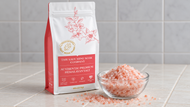
Himalayan pink salt comes from ancient rock-salt deposits associated with Pakistan's Salt Range, including the well-known Khewra mining area in Punjab. It is mined rock salt, rather than salt newly harvested from a present-day coastal evaporation pond. That distinction explains the origin—but a useful bath-and-body purchase also depends on processing, grain size, ingredient identity, and the finished formula.
This guide connects the sourcing story with practical choices in The Midwest Sea Salt Company's Himalayan soaks and scrubs. It separates what is known about the ingredient category from what should be documented for a particular shipment or product.
Where the Himalayan salt name leads
The Salt Range and Khewra Salt Mine description hosted by UNESCO provides historical and geological context for the rock-salt deposits. Other producing areas also exist. A Himalayan label is therefore not, by itself, a complete record of a specific mine or batch.
The broader origin is the remnant of ancient salt deposits. Today's supply chain extracts and processes that rock for different markets. The Trade Development Authority of Pakistan's sector overview distinguishes rock-salt regions from coastal sea-salt production and identifies bath and spa products among the uses of processed salt.
For a consumer, this explains why Himalayan salt has a different origin story from sea salt. For a brand, it creates a second question: which records connect the material you are buying to the origin and specification you intend to describe?
From rock deposit to finished bath ingredient
A rock-salt origin does not mean every supplied crystal has the same size, appearance, or intended use. Between extraction and sale, a material may be sorted, reduced in size, screened, and packed according to the supplier's process and the buyer's requirements.
These operations matter because bath products must be usable. Large decorative crystals can create a different pouring and dissolution experience from a fine material. A salt selected for an exfoliating formulation raises different particle and texture questions from one intended to dissolve in water.
When purchasing commercially, ask for the supplied specification rather than relying on the photograph. The details you need can include declared identity, particle-size range, available quality documentation, batch identification, and storage conditions. The mine story is valuable context, but it cannot substitute for the delivered material's specification.
Fine grain and coarse grain: a real product choice
Our Unscented Authentic Premium Himalayan Bath Salt Soak offers fine and coarse grain selections. The displayed options identify approximately 0.3 mm fine grain and 2 mm coarse grain, along with several bag sizes. This makes grain size a purchase decision rather than merely a descriptive word.
Choose with the intended experience in mind. A fine-grain material can be easier to distribute through a blend, while larger crystals create a more pronounced visual texture. Under otherwise similar conditions, smaller particles generally expose more surface area to the water, which can affect dissolution rate. Water movement and the amount used still matter.
Do not assume coarse grain is more concentrated or that darker crystals provide greater benefits. If you are comparing options for a soak, look at how they pour, how readily they dissolve under the directed conditions, and whether their appearance fits the product you want.
What makes the salt pink?
Mineral variation contributes to the characteristic range of Himalayan salt colors. Pink is recognizable, but color should not be used as a stand-alone purity test. Deposits can contain different shades, and a photograph cannot establish a contaminant profile or verify a batch's suitability for cosmetic use.
It is also a mistake to turn a trace-mineral story into a specific health promise. The presence of naturally occurring minerals does not, on its own, show that a bath detoxifies the body, treats a condition, or supplies a meaningful nutritional dose. Keep the claims connected to the actual product and evidence.
When color consistency matters for a retail range, discuss a realistic appearance specification. Natural variation and a tightly controlled uniform visual target are different expectations; agreeing on that point early helps avoid rejecting an acceptable material because a new bag is not identical to a styled photograph.
Himalayan bath salt versus Himalayan body scrub
A soak and a scrub use the mineral in different ways. In a soak, the salt is added to water according to the product directions. A scrub is applied to damp skin and rinsed away after gentle massage. The rest of the formula changes the experience.
For example, our Exfoliating Himalayan Salt Scrub lists Himalayan sodium chloride alongside glycerin, sweet almond and jojoba oils, oat and arnica extracts, tocopherol, and sunflower oil, with optional essential oils. It is not simply the dry soak placed in a different jar.
That difference gives the link a purpose: choose the dry soak if you want a dissolving mineral bath; compare the scrub if your aim is physical body exfoliation with an oil-containing base. Review the specific selected scent option and ingredient list before ordering.
How to compare Himalayan salt with other bath minerals
Himalayan pink salt is a sodium-chloride-based material. Our Himalayan pink salt ingredient reference explains its ingredient identity and use in bath and body formulas. Epsom salt is magnesium sulfate. Dead Sea salt and sea salt represent other mineral sourcing categories. They should not all be treated as the same ingredient with different colors.
The Unscented Bath Salt Sampler Set includes separate Dead Sea, Pacific sea, Himalayan, and Epsom samples. It is useful for examining texture and comparing materials before choosing a larger quantity. Record observations on each sample separately rather than mixing them immediately and losing the ability to tell which property came from which material.
For a finished-product comparison, our Dead Sea salt versus Himalayan salt guide discusses the question in the context of bath routines.
Is Himalayan pink salt sustainable?
A country-of-origin statement cannot answer that question on its own. Assessing a particular supply chain requires evidence about extraction practices, worker conditions, processing, transport, packaging, and the supplier's controls. A claim about a large salt deposit would answer a supply question; it would not establish low environmental impact or fair labor conditions.
For a bath-and-body brand, separate the claims you can document from the questions still to investigate. Ask which operation a sourcing statement covers, whether the evidence is current, and how it relates to the material supplied. A general description of mining in Pakistan does not prove that a particular bag follows every practice described.
For a home buyer, clear ingredient identity and usable product directions are practical starting points. If environmental or labor assurances are central to your purchase, look for specific, traceable statements rather than assuming that natural, hand-harvested, or pink means independently verified.
What responsible sourcing questions actually ask
Traceability, environmental practices, labor conditions, and product quality are related topics, but they are not interchangeable claims. A supplier can identify a country of origin without proving a particular environmental certification. A quality document can describe a material without documenting labor conditions at the mine.
Ask for the evidence that matches the statement you want to make. If a brand plans to mention a named mine, request support for that connection. If it intends to claim a certified practice, verify the certificate's scope and applicability. Avoid implying that every pink-salt supplier has identical practices.
Origin information is most useful when the stated relationship can be verified. Our sea-salt sourcing guide provides a useful comparison with a different supply path.
Choosing the right Himalayan product
For home bathing, decide whether you want an unscented mineral format or a finished aromatic soak, then check the available size and grain options. For a scrub, evaluate the complete oil-and-particle formula. For a commercial concept, define the texture, scent, package, and documentation needs together.
Explore Himalayan bath salt soaks or Himalayan salt scrubs according to that intended use. Brands can bring those requirements to our bulk formulation team. A sourcing story becomes most useful when it leads to a clear, suitable product specification.