
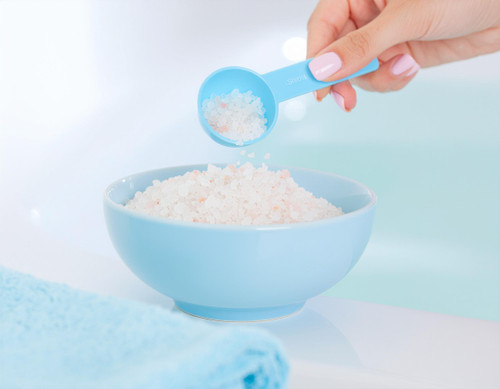
How to Measure Bath Salt Properly (Without Guesswork)
Posted by Midwest Sea Salt Co. on 8th Mar 2026
Measuring bath salt is often treated as an afterthought, yet it has a significant impact on how a bath feels. Too little salt may feel ineffective, while too much often provides no additional benefit and can interfere with dissolution.
Rather than relying on guesswork, understanding how salt behaves in warm water makes measurement simple, repeatable, and predictable.
Why Measurement Matters
Bath salts do not dissolve or disperse in water in the same way across all conditions. Water volume, salt grain size, and temperature all influence how much salt is needed to achieve a balanced experience.
Using consistent measurements helps eliminate variability. When each bath starts the same way, it becomes easier to notice whether adjustments are actually improving the experience.
Start with Tub Size
Most standard bathtubs hold between 40 and 50 gallons of water when filled to a comfortable soaking level. For this size, 1 to 2 cups of bath salt provides a reliable starting range.
Deep soaking tubs may require slightly more, while smaller tubs may need less. Increasing the amount gradually helps prevent overuse.
How Salt Type Affects Measurement
Not all bath salts behave the same way. Fine-grain salts dissolve quickly and distribute evenly with smaller amounts. Coarser salts dissolve more slowly and may require slightly higher volume to achieve the same water feel.
This is why measuring by volume rather than weight is typically more practical for home use. Visual consistency matters more than exact numerical precision.
Adding Salts Correctly
Bath salts should be added to warm running water rather than a still tub. Water movement helps encourage even dissolution and prevents salt from settling at the bottom.
If salt remains undissolved or the water becomes cloudy, the amount may be higher than necessary for that salt type or tub size.
Why More Is Not Better
Adding excessive bath salt does not increase effectiveness. Once the water reaches saturation for a given salt, additional material simply sits unused.
Many people mistakenly increase salt amounts over time, assuming more equals better. In reality, consistency is more important than intensity.
Building a Repeatable Routine
Choose a baseline amount—such as 1½ cups—and use it consistently for several baths. Only adjust after multiple uses, and change amounts in small increments.
Separating salt measurement from fragrance or botanical additions also improves control. This is why scent is often handled independently, using gentle profiles like Cucumber Fragrance Oil rather than increasing salt volume to compensate.
Why Measurement Supports Long-Term Use
When bath salt usage becomes predictable, the bath shifts from an occasional indulgence to a dependable routine. Consistent measurement reduces waste, improves comfort, and makes the experience easier to repeat.
This clarity-first approach aligns with how usage guidance is developed at The Midwest Sea Salt Company, where product performance is supported through clear, repeatable use rather than guesswork.
Measuring bath salt properly is not about precision—it is about building confidence. When the process becomes intuitive, the bath becomes more enjoyable.