
From Sample to Shelf: What Happens After You Approve Your Private Label Formula?
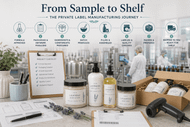
Getting a private label product sample into your hands is an exciting milestone. You can finally see the color, smell the fragrance, feel the texture, evaluate the consistency, and experience the product much the same way your future customers will.
Then comes the moment every product developer has been working toward: you approve the formula.
For the brand owner, it can feel like most of the work is finished. The formula is right. The fragrance is right. The product finally feels like yours. But from a manufacturing perspective, approval marks the beginning of an entirely different phase of the project.
Now we have to take something that may have been carefully prepared as a development sample and turn it into hundreds, thousands, or potentially tens of thousands of consistent retail units.
That transition requires coordination between formulation, procurement, packaging, graphics, production, quality control, labeling, assembly, and shipping. Every component has to come together at the right time so that the product you approved as a sample can become the product your customers ultimately receive.
At The Midwest Sea Salt Company, this is where product development turns into manufacturing. Here is what happens behind the scenes as an approved private label formula makes its way from sample to shelf.
Step 1: The Formula Is Approved
Before production can move forward, the client needs to be comfortable with the product itself.
During development, there may have been conversations about texture, fragrance, color, ingredients, exfoliation level, viscosity, or other characteristics. Samples may have been created and adjusted based on feedback.
Perhaps a scrub needed slightly more fragrance. Maybe a bath soak needed a different color. A body oil might have needed a lighter skin feel. A formulation could have been exactly right on the first attempt.
Once the customer says, "This is the product I want," we have an approved direction.
That approval is extremely important because manufacturing requires consistency. We are no longer experimenting with what the product could become. We are establishing what it is.
Step 2: We Turn the Approved Product Into a Defined Manufacturing Project
A finished product is much more than its formula.
Consider a seemingly simple 16 oz body scrub. The finished retail unit could involve the scrub formula, jar, lid, heat induction seal, printed label, fragrance, color, ingredient declaration, fill weight, case configuration, and shipping requirements.
All of those details need to work together.
This is why one of the most important parts of private label manufacturing is clearly defining the complete project scope.
At this stage, we are confirming details such as:
- Approved formulation
- Product size or net contents
- Container
- Closure
- Seal or tamper-evident components when applicable
- Fragrance
- Color
- Label requirements
- Ingredient deck
- Order quantity
- Packaging configuration
- Other product-specific requirements
The objective is simple: eliminate ambiguity before production begins.
Step 3: Packaging Is Finalized
Packaging is one of the most important—and sometimes underestimated—parts of developing a successful bath and body product.
A formula and its package have to work together.
Thick scrubs generally need packaging that allows customers to access the product comfortably. Oils require closures designed for controlled dispensing. Bath salts need packaging capable of handling the weight and characteristics of the formula. Lotions and washes have their own viscosity and dispensing considerations.
Packaging also affects how the product is manufactured.
The container opening, closure style, label dimensions, seal, product viscosity, and overall dimensions can influence how efficiently a product moves through filling, sealing, labeling, and packaging equipment.
This is one of the advantages of working with an experienced private label manufacturer. Packaging decisions are not made solely on appearance. We can consider what happens when that package reaches an actual production line.
Step 4: The Label and Artwork Process Moves Forward
Once the packaging has been established, the brand needs artwork that fits the selected container and communicates the product appropriately.
For many projects, our graphics team can provide the necessary artwork dimensions or template so the customer or their designer knows the available print area.
This is where the product begins to visually become a brand.
The same formula placed into two differently branded packages can tell two completely different stories. One might be positioned as an upscale spa treatment. Another could target an active lifestyle customer. Another might be playful, colorful, and designed for social media or gifting.
The underlying manufacturing may be similar, but branding determines how consumers first experience the product.
Once final artwork is submitted, it can be reviewed and a proof prepared when applicable. The customer then has an opportunity to review the proof before printing moves forward.
This approval step matters. A production run is not the place to discover that a logo is positioned incorrectly or that the wrong artwork file was submitted.
Step 5: Ingredients and Components Have to Be Procured
While artwork is moving forward, another critical process is happening behind the scenes: procurement.
A manufacturer cannot make 1,000 finished units simply because the formula has been approved. Every ingredient and packaging component required for those 1,000 units has to be available.
Depending on the project, that could include:
- Base ingredients
- Specialty ingredients
- Botanical ingredients
- Fragrance or essential oils
- Colorants
- Containers
- Lids or closures
- Pumps or dispensing components
- Induction seals
- Labels
- Cases and shipping materials
A single missing component can prevent a finished product from being completed.
This is why procurement is such an important part of professional manufacturing. We are not simply asking, "Do we have enough ingredients to make the formula?" We are asking, "Do we have everything required to produce the complete quantity of finished units?"
Step 6: The Project Is Prepared for Production
Once the required components are available and the necessary approvals have been completed, the project can move toward production scheduling.
Manufacturing schedules have to coordinate different products, batch sizes, equipment requirements, staffing, filling methods, and packaging configurations.
A dry bath salt blend does not necessarily travel through the same process as an emulsified sugar scrub. A body oil behaves differently from a thick cream. A gallon bulk product has different production requirements than thousands of individual retail jars.
Experienced manufacturing is about matching the product to the appropriate process.
This is also why scalability should be considered early in product development. A product that is enjoyable to make by hand in a small development batch still needs to make sense when production increases dramatically.
Step 7: The Formula Becomes a Full Production Batch
This is where the transformation really begins.
Instead of producing a small development sample, our production team now manufactures the formula at commercial scale according to the approved specifications.
Ingredients are weighed and processed according to the manufacturing requirements for the formula. Mixing procedures, ingredient additions, and processing steps need to be controlled so the finished batch reflects the approved product direction.
Scale changes the manufacturing environment considerably.
Making one jar of scrub on a development bench is very different from manufacturing enough scrub for hundreds or thousands of jars. Professional equipment, defined processes, production experience, and quality procedures become increasingly important as volume grows.
The objective is not simply to make a large quantity of product. It is to make a large quantity that consistently represents the product the customer approved.
Step 8: Filling Begins
Once the bulk formula is ready, it needs to become individual units.
This is where filling equipment and production automation can dramatically change the economics of private label manufacturing.
Depending on the product, containers are introduced into the production process and filled with the appropriate amount of formula. The filling method needs to match the characteristics of the product.
A free-flowing body oil behaves very differently from a dense scrub. Dry salts have different handling requirements from creams and lotions. Production equipment and procedures must accommodate those differences.
Efficient filling is especially important as brands grow. What may be manageable by hand at extremely small quantities quickly becomes impractical when demand reaches thousands of units.
Step 9: Sealing and Closing the Product
After filling, the container still needs to become a secure retail unit.
Depending on the packaging configuration, that may involve installing a heat induction seal, applying a closure, tightening a lid, adding a pump, or completing another packaging operation.
These details may seem minor when looking at a finished product on a shelf, but they are important parts of the customer experience.
The consumer should receive a product that feels professionally manufactured from the moment it arrives.
Step 10: Labels Bring the Brand to Life
There is an interesting moment on a private label production line when an ordinary container suddenly becomes recognizable as a finished brand.
That moment often happens when the label is applied.
Before labeling, you may see rows of identical white jars or bottles. Afterward, they carry the customer's logo, product name, branding, colors, and product information.
It is one of the most visually dramatic parts of private label manufacturing because all the work that happened during formulation and design suddenly becomes tangible.
Automated or production-scale label application also helps create consistency across a run so the finished units have a uniform retail appearance.
Step 11: Quality Control Happens Throughout the Process
Quality is not something that should be checked only after the last unit comes off the line.
Professional manufacturing involves checkpoints throughout the process.
The exact procedures depend on the product and project, but quality considerations can include formula consistency, component verification, fill levels, packaging integrity, labeling, seals, closures, and overall finished-unit appearance.
This is also one reason documentation matters when selecting a manufacturing partner.
Brands eventually need more than a product that looks attractive. As they grow into larger retailers, distributors, marketplaces, or professional channels, they may be asked for product documentation and manufacturing information.
Working with an established manufacturer creates a much stronger foundation for that growth than attempting to reconstruct documentation after a product has already become successful.
Step 12: Product Documentation Matters
Private label manufacturing does not stop with mixing and filling.
Documentation is an important part of operating a serious bath, body, and cosmetic brand.
Depending on the product and circumstances, documentation may include items such as a Safety Data Sheet (SDS), Certificate of Analysis (COA), ingredient information, and other applicable product or compliance documentation.
This becomes increasingly important as a brand grows.
A small online seller may not initially receive many requests for documentation. A larger retailer, distributor, hotel group, spa organization, or other commercial customer may have considerably more detailed requirements.
Building the product correctly from the beginning can make those future conversations significantly easier.
Step 13: Finished Units Are Packed for Shipment
Once manufacturing and final assembly are complete, the finished products need to leave the production environment safely.
Units are packed into cases according to the project requirements and prepared for their next destination.
That destination can vary significantly.
Products might be going to the client's warehouse, a third-party logistics provider, an e-commerce fulfillment operation, a retail distribution point, or another commercial location.
Shipping should therefore be considered part of the project—not an afterthought.
A beautiful retail product still needs to survive the journey from the manufacturing facility to wherever inventory will ultimately be stored and distributed.
Step 14: The Finished Product Is Ready to Become Inventory
This is the moment the original idea becomes real.
What started as a conversation—"We want to create a body scrub," "We have an idea for a bath soak," or "We want our own line of body oils"—is now physical inventory.
There are finished products in cases, ready to enter the client's sales and distribution system.
For a new entrepreneur, seeing those first finished units can be an enormous milestone. For an established company, it may represent another SKU being added to a growing product portfolio.
Either way, the journey from sample approval to finished inventory involves considerably more than simply making a larger batch.
Then Comes the Most Important Test: What Do Customers Think?
Manufacturing the first order is only the beginning of the product's commercial life.
Now the brand gets real-world information.
Do customers like the fragrance? Do they reorder? Which marketing messages resonate? Does the 16 oz size outperform the smaller option? Does the product sell better individually or as part of a bundle? Are customers asking for additional fragrances?
Those answers help determine what happens next.
A strong first product can become the foundation for an entire collection.
What Happens When 1,000 Units Become 10,000?
This is where working with a scalable manufacturing partner becomes particularly valuable.
A brand might begin cautiously with its first production run. If the product performs well, the next order could be substantially larger.
Instead of reinventing the product every time, the goal is to have a defined formula, established packaging, approved artwork, known components, and a repeatable manufacturing process.
Reorders can then become part of an ongoing production relationship.
As volume grows, the conversations may also change. Larger component purchases, production efficiencies, packaging options, freight considerations, and additional SKUs can become relevant.
The product itself becomes the foundation from which the brand grows.
Why Manufacturing Experience Matters After Sample Approval
It is relatively easy to make something impressive in a small container.
The much harder challenge is making that product consistently at commercial scale, putting it into thousands of packages, sealing those packages, labeling them correctly, preparing the necessary documentation, packing the finished units, and doing it again when the customer reorders.
That is the difference between product experimentation and manufacturing.
When evaluating a private label partner, brands should look beyond the sample itself and ask an equally important question:
What happens if this product becomes successful?
Can the manufacturer support larger orders? Can it procure components consistently? Does it have production equipment? Does it understand packaging? Can it provide appropriate product documentation? Can it help the brand move from an initial launch into repeat production?
The best time to think about those questions is before the product takes off.
Your Manufacturer Becomes Part of Your Supply Chain
A private label manufacturer is not simply a company that fills jars.
Once a product enters the market, the manufacturer becomes an important part of the brand's supply chain.
When inventory begins running low, the brand needs to know that another production run can be created. When sales grow, manufacturing capacity needs to grow with them. When a retailer asks for documentation, the brand needs a partner capable of supporting those requirements.
That relationship becomes increasingly important as the business expands.
From One Product to an Entire Brand
Many brands do not begin with twenty products.
They begin with one.
One great scrub. One bath soak. One body oil. One soap. One product that customers try, enjoy, and purchase again.
Once that foundation exists, expansion becomes much more strategic.
A successful lavender scrub could lead to additional fragrances. A popular bath soak could become an entire wellness collection. A body oil could inspire complementary scrubs, soaps, or shower products.
The knowledge gained from the first manufacturing project makes each future project easier to understand.
Ready to Take Your Product From Sample to Shelf?
If you have an idea for a bath, body, spa, or personal care product, you do not need to have every manufacturing detail figured out before contacting us.
Some customers arrive with detailed formulas and established brands. Others begin with little more than an idea, target size, approximate quantity, and vision for the type of customer they want to reach.
Our job is to help turn those ideas into a defined manufacturing project.
From formulation and sampling through packaging, procurement, production, filling, labeling, assembly, and shipment, The Midwest Sea Salt Company's Private Label Program is designed to help brands move beyond the idea stage and into real-world manufacturing.
Because approving the sample is an exciting milestone—but seeing cases of your own finished products ready to ship to customers is when the idea truly becomes a brand.