
From Idea to Amazon: How a Private Label Scrub Goes From Concept to Finished Product
Many private label projects do not begin with a finished formula, a completed brand guide, or a fully defined product plan. More often, they begin with a simple idea and a market opportunity.
That is exactly how one private label scrub project might begin at The Midwest Sea Salt Company.
A customer reaches out and explains that she wants to create a body scrub to sell on Amazon. She is not completely sure what kind of scrub she wants yet, but she knows there is demand in her market. She wants the product to be colorful, retail-ready, packaged in a 16-ounce jar, and produced in an opening run of roughly 500 to 1,000 units.
This type of inquiry is common. Many customers know the direction they want to move in, but they need help turning that direction into a real product. That is where the private label process begins.
The Initial Idea
At the start of the project, the customer’s direction is intentionally broad. She wants a scrub, she wants it to feel marketable, and she wants it to work well for Amazon fulfillment. She does not yet know the fragrance, color direction, ingredient structure, or packaging details.
Rather than expecting the client to have every answer upfront, our job is to help translate the idea into a practical product concept. We look at the customer’s goals, sales channel, target quantity, packaging needs, and overall positioning.
In this case, the customer wants something colorful and approachable that can stand out online while still feeling familiar enough for repeat purchase.
Product Development Review
Once the inquiry is received, our product development team reviews the project internally. This includes evaluating what the customer asked for, what has performed well across similar projects, and what type of formulation would make sense for the intended launch.
Because we manufacture thousands of bath and body products, we are able to draw from real production experience. We see what customers reorder, which fragrance directions remain consistently popular, and which product formats tend to perform well over time.
For this project, we recommend developing a lavender scrub. Lavender continues to be one of the most frequently requested and broadly appealing fragrance directions in bath and body. It is recognizable, versatile, and familiar to a wide range of consumers.
That insight helps guide the initial product concept.
Developing the Proposed Formula
After selecting the direction, our in-house chemists begin developing a proposed formulation. Since the customer’s original direction is fairly open, this stage is focused on creating a strong starting point that matches her goals while remaining practical for production.
The proposed ingredient deck is:
Sodium Chloride, Carthamus Tinctorius (Safflower) Seed Oil, Glycerin, Silica Dimethyl Silylate, Tocopherol, Mentha Piperita (Peppermint) Oil, Citrus Grandis (Grapefruit) Fruit Extract, Cymbopogon Schoenanthus Extract, Mentha Viridis (Spearmint) Leaf Extract, Fragrance, FD&C Colorants.
This formula direction gives the scrub structure, texture, emollience, fragrance, and visual appeal. The sodium chloride provides the exfoliating base. Safflower seed oil helps create glide and skin feel. Glycerin supports the overall feel of the product, while silica dimethyl silylate helps with texture and oil suspension. Tocopherol is included as part of the oil phase, and the botanical extracts help round out the concept.
The use of FD&C colorants allows the scrub to move in the colorful direction the customer requested, while fragrance creates the final sensory identity.
Packaging Direction
Formula is only one part of the product. Packaging also matters, especially for a product being sold online.
For this project, we recommend a clean white PET jar with a white lid. This gives the customer a neutral packaging foundation that works well with many branding styles. A white jar and lid create a blank canvas for label artwork, allowing the brand identity to carry the product visually.
We also recommend a heat induction seal. This helps protect the product during handling and shipment while giving the finished unit a more retail-ready presentation.
The proposed package includes the jar, lid, heat induction seal, custom printed label, label application, filling, assembly, and packaging for shipment.
Presenting the Initial Direction
Once the formulation and packaging direction are developed, we send the client an email outlining the concept.
The email includes the proposed product direction, ingredient deck, fragrance recommendation, color direction, and packaging recommendation. We also explain that the product can be adjusted based on her preferences.
This is an important part of the process. Private label development is collaborative. The first concept is not meant to limit the customer—it is meant to give them something clear and practical to react to.
In this example, the customer likes the direction and asks to see pricing based on the proposed project scope.
Pricing the Project
Once the customer approves the general direction, the project moves to our pricing team. The pricing department reviews the full scope, including the formula, packaging, label, assembly, and production requirements.
For this 16-ounce scrub in a white PET jar with white lid, heat induction seal, custom lavender scrub formula in a purple tone, printed label, label application, assembly, and packaging, the estimated pricing is:
500 units: $7.12 per unit
1,000 units: $6.40 per unit
These prices are all-in manufacturing costs, excluding freight to the final destination.
That means the pricing includes the jar, lid, seal, custom scrub, filling, assembly, custom printed label, label application, and packaging for shipment. The only additional cost is shipping the finished goods to the customer’s final destination or fulfillment center.
Creating a Custom Sample
Before moving into production, we recommend creating a custom sample. For this project, the custom sample fee is $50.
The customer agrees and orders the sample.
At that point, our chemists produce the actual formula that was proposed. This is not a generic sample pulled from a shelf. It is made based on the direction discussed with the client.
The sample is then mailed to the customer for review.
Reviewing Feedback
After receiving the sample, the customer reviews the scrub and provides feedback. She likes the feel, texture, color, and overall formulation direction. The only adjustment she requests is to increase the lavender fragrance.
This is exactly why sampling matters.
Small adjustments are much easier to make before production begins. A change in fragrance strength, color tone, or texture can be evaluated, revised, and approved before thousands of units are produced.
Our team makes the adjustment and creates a second sample for final review.
The customer receives the revised sample and loves it.
Moving Into the Proposal Stage
Once the formula is approved, we put the full project into a formal proposal.
The proposal includes the complete project scope, packaging details, formula direction, seal details, label requirements, ingredient deck, pricing, quantity, and all responsibilities required to complete the product and make it retail-ready.
This proposal becomes the working blueprint for the project.
The customer chooses to proceed with 1,000 units. At $6.40 per unit, the total project value is $6,400.
The client signs the proposal and pays the 50% deposit directly through the proposal system. Once that is complete, the project officially moves forward.
Artwork and Label Setup
After the project is approved, our graphics team creates a label template for the client. This template gives the customer the correct dimensions and layout requirements needed to create the artwork.
Once the customer completes the artwork, they send it back to us. Our team then creates a proof for approval before labels are printed.
This proofing step is important because it ensures that everyone signs off on the final visual presentation before production begins.
Procurement and Scheduling
While artwork is being finalized, our procurement team begins ordering the components needed for the project. This includes packaging, raw materials, ingredients, labels, seals, and any other required production materials.
Once the components and ingredients arrive, the project is placed on the production schedule.
At this point, everything has been approved: the formula, the package, the label, the quantity, and the production scope.
Production Begins
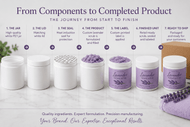
Once production begins, the separate components start coming together.
The custom scrub is manufactured according to the approved formula. The jars and lids are staged. Labels are prepared. Seals are ready. The production line is set up for the project.
This is the point where months of planning, sampling, pricing, artwork, procurement, and approvals turn into finished retail units.
The project starts at the beginning of the production line as individual components and comes out the other end as a completed product: filled, sealed, labeled, and ready to pack for shipment.
An order of 1,000 units can be completed quickly once everything is staged correctly. With the right automation and preparation, the actual production run may take only a short amount of time. The speed is possible because the planning work has already been done.
Finishing the Order
Once the order is completed, we notify the customer that production is finished. We then send the invoice for the remaining balance.
After the balance is paid, we collect the shipping plan and move the finished goods to the final destination. For an Amazon-focused brand, that may mean shipping directly into the appropriate fulfillment network.
At that point, the customer has a finished, retail-ready scrub that started as a simple idea.
Why This Process Works
This example shows how private label manufacturing turns an idea into a product through a structured process.
The customer did not need to know the formula. She did not need to source jars, lids, seals, labels, or ingredients. She did not need to own filling equipment or understand production scheduling.
She needed an idea, a target market, and a willingness to collaborate.
Our team handled the rest: concept development, formulation, sampling, pricing, packaging support, procurement, production, labeling, filling, assembly, and shipment preparation.
Getting Started With Your Own Private Label Product
Many successful products begin with an incomplete idea. A customer may know they want to sell a scrub, soak, oil, body butter, or bath product, but they may not know exactly how to build it.
That is where the right manufacturing partner matters.
If you are interested in creating your own private label bath or body product, you can learn more and get started here: The Midwest Sea Salt Company Private Label Program.
Whether you have a fully developed concept or only the beginning of an idea, the process is designed to help turn that idea into a finished product that is ready to sell.