
Custom Printed Pouches for Private Label Bath & Body
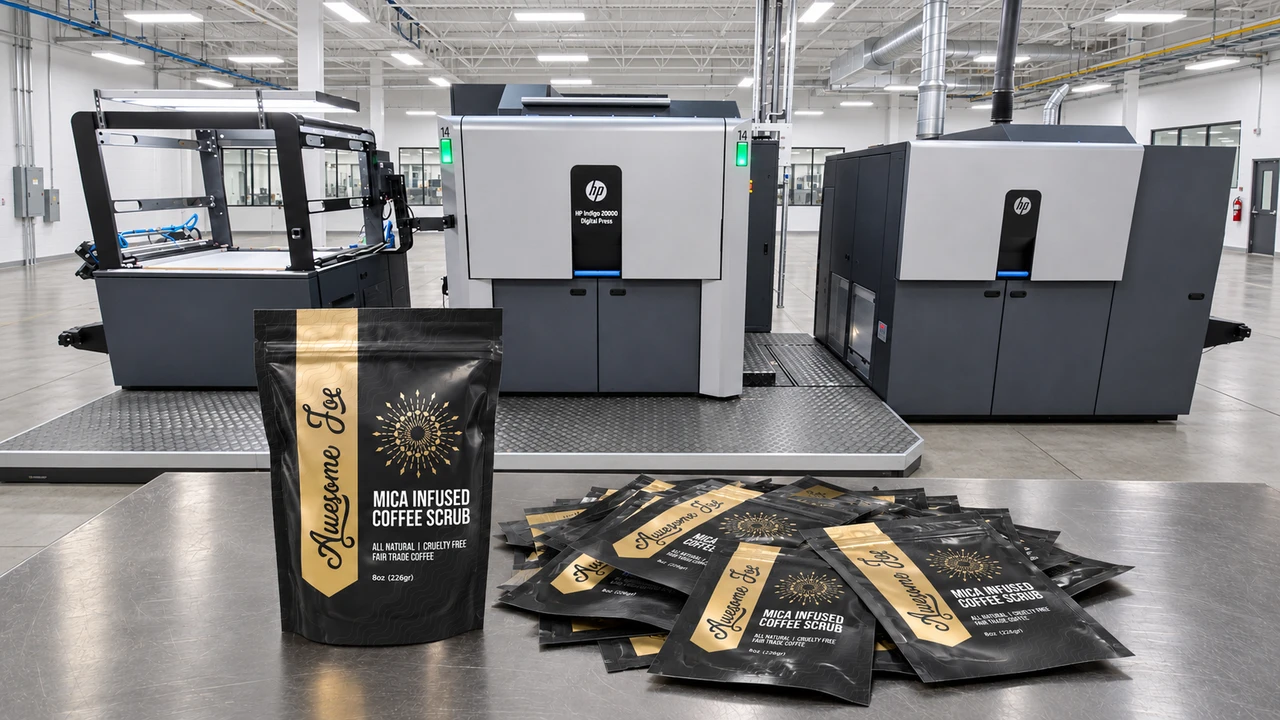
A custom pouch can change more than the way a bath and body product looks. For the right formula, it can replace several packaging components, simplify production, and make a branded product more practical to launch and reorder.
The Midwest Sea Salt Company has purchased and installed an HP Indigo 20000 digital press with 25K upgrades, expanding our in-house pouch manufacturing capabilities. For our private label customers, the benefit is straightforward: digitally printed custom pouches at smaller quantities, with faster turnaround than our traditional pouch production route.
Our custom pouch minimum is 1,000 units per SKU. In most cases, eligible digital pouch orders can be completed in approximately 3–4 weeks after we receive production-ready artwork and final approval. The formula, packaging requirements, material availability, and production schedule still need to be confirmed for each project.
What the new digital press changes for your brand
Traditional custom packaging can require a substantial commitment before a new design reaches the shelf. Digital printing gives us another way to manage that first run, particularly when a brand wants to introduce a product, test a new scent, or refresh its packaging without committing to a much larger printed inventory.
Our HP Indigo press prints from digital artwork without the engraved image cylinders used in rotogravure. Removing that cylinder preparation step makes design changes and shorter print runs more practical. A seasonal design or revised back panel can move through a digital workflow without creating a new set of engraved cylinders.
We chose this wide-web platform, approximately 760 mm across, to support efficient layouts for a broad range of pouch sizes. That describes the material running through the press, rather than the width of a finished pouch. The final package still has to be sized around its contents, fill weight, seals, and intended use.
HP Indigo also offers expanded color options beyond standard four-color printing. For a brand, the useful result is greater flexibility when reproducing artwork, photography, and distinctive color palettes. We review the artwork and proof for the selected film; an on-screen color or a Pantone reference alone is not a guarantee of an identical finished print.
Why a pouch can reduce the cost of a finished product
A jar-based product can involve a container, lid, separate printed label, and an inner seal, as well as the work required to assemble them. A suitable custom printed pouch can bring the printed branding and product containment into one package. It still requires a properly designed closure and production seal, but it can eliminate the need to purchase and handle several separate jar components.
That difference matters throughout production. There are fewer separate components to coordinate, fewer opportunities for a missing lid or delayed label to interrupt a run, and a different approach to storing empty packaging. A pouch can also provide a substantial printable surface for the product story, directions, ingredients, and brand identity.
Because we manufacture both the product and its pouches in-house, we can evaluate formula cost, package construction, filling, and assembly together. That coordination gives us more control over the complete manufacturing cost and can create substantial savings on suitable projects. The digital press improves the print-production step within that larger process.
The useful comparison is the cost of the finished, filled product delivered in saleable condition. An inexpensive empty pouch does not tell you whether its barrier, closure, dimensions, or filling requirements are right for your formula. Likewise, a lower package weight may help freight, but dense salts still carry their own shipping weight. We compare the actual specification rather than promising the same saving for every product.
Which bath and body products are worth considering for pouches?
Bath salts and mineral soaks
Dry mineral products are a natural starting point. Epsom salt, sea salt, Dead Sea salt, Himalayan salt, and blended bath soaks can suit a pouch format when the material and seal provide the protection the formula needs. The pouch can support a simple mineral presentation or carry full-color branding for a fragranced collection.
Our Mentally Elsewhere Bath & Foot Soak – Island Coconut Silk, from our Mood Soaks range, shows how a printed stand-up pouch can give a mineral soak its own distinctive identity. For a private label version, we evaluate grain size, added oils or botanicals, fill weight, and moisture protection together. A coarse blend and a fine mineral powder should not automatically receive the same package specification.
Foot soaks and focused scent collections
Foot soaks offer a clear product story for spas, gift retailers, and brands building an at-home routine. A printed pouch can give each scent a recognizable identity while keeping directions and product information on the package.
For a real format example, look at Running On Empty Bath & Foot Soak. The retail product shows how a pouch can carry a distinctive design around a bath and foot-soak concept. A custom project would use your own approved formula, branding, and specifications rather than simply reproducing our retail packaging.
Magnesium flakes and other moisture-sensitive minerals
Our Magnesium Crystal Flakes Bath Soak – Calming – 20 oz illustrates another product and package size in a printed stand-up pouch. Magnesium-based products need protection during distribution and everyday handling, and a resealable feature only helps when it closes properly after use. Film selection, seals, and directions for keeping the contents dry matter alongside the finished design.
We also consider the amount of space the product occupies. Flakes, fine salt, and coarse crystals can require different pouch dimensions at the same stated weight. Package size should follow a filling assessment, not a comparison with another brand’s bag.
Sugar, salt, and coffee body scrubs
Body scrubs create a different opportunity. A pouch may suit a refill concept, a portable format, or a brand seeking an alternative to a jar. But a scrub’s oils, particle size, thickness, and dispensing behavior need to be assessed before the format is approved.
Our Awesome Joe All Natural Mica Infused Coffee Scrub – 8 oz is a practical example of an exfoliating body product sold in a printed stand-up pouch. Its coffee, Dead Sea salt, and plant-oil formula shows why packaging has to suit more than dry minerals. For a custom scrub, film compatibility, oil resistance, seal performance, and access to the product all need to be evaluated together.
Dry masks, powders, and other formulations
Dry clay masks and body-care powders may also be candidates, with attention to dust control, moisture protection, and accurate dispensing. Lotions, washes, gels, and other liquids require a separate compatibility and dispensing review. A successful salt pouch is not proof that the same construction will work for a liquid or cream.
The right question is whether the complete formula can be filled, sealed, shipped, and used reliably in the proposed package. We confirm that fit before committing a product to pouch production.
Digital printing and rotogravure: two useful production routes
We will continue manufacturing rotogravure pouches alongside the new digital offering. Having both routes allows us to match production to the project rather than forcing every order through the same process.
Rotogravure transfers ink from engraved cylinders onto film. Preparing those cylinders adds setup time and cost, but the process can become very economical for large, repeat orders where that investment is spread across many units. It remains an important option for established products with predictable demand.
Digital printing is particularly useful when the priority is a smaller initial run, faster artwork changes, or a shorter route into production. There is no universal order quantity where one process becomes the better value: pouch dimensions, artwork, materials, repeat volume, and finishing requirements all affect the comparison.
Metallic effects, surface finishes, and any embossed features need their own production review. They depend on the material and finishing process; they are not automatic features of either printing method. Brand-critical colors should also be reviewed through the appropriate proofing process.
Plan around 1,000 units per SKU
The minimum for our custom pouches is 1,000 units per SKU. If you plan two separate scent SKUs, that means a minimum of 1,000 units of each, or 2,000 units in total. Sharing a design style across the collection does not combine separate SKU minimums.
For a first launch, one or two well-defined products can be easier to finance and manage than a large collection. Digital printing makes a smaller run more practical, but the amount you order should still reflect your sales forecast, storage capacity, budget, and reorder plan.
Existing brands can use the same approach when moving from jars into pouches. Compare a defined product and fill size, assess the customer experience, and review the finished cost before converting an entire line. A pouch can be an alternative primary package or part of a refill strategy, depending on the product.
What happens during the typical 3–4 week production window?
For most eligible digital pouch projects, our expected order-completion window is approximately 3–4 weeks after receipt of production-ready artwork and final approval. This is an estimate for the agreed project, not a guaranteed delivery date for every formula and packaging combination. Shipping time and any development needed before approval should be planned separately.
We provide the pouch template, and you or your designer create and supply the artwork using that template. Once the completed artwork is finalized and approved, we can move forward with printing and production.
Printing is one stage of making a pouch. Depending on the construction, the workflow also includes the necessary film preparation, lamination, curing, pouch conversion, filling, and sealing. Faster printing helps the overall schedule, while the rest of the process still has to protect the product and produce a reliable finished package.
Start with your product, quantity, and target cost
To evaluate a custom pouch project, tell us the product type, intended fill weight, number of SKUs, quantity per SKU, preferred look, target finished-unit cost, and desired launch date. If you already sell the product in a jar, include the current package size and explain what you want to improve.
Our private label product brief guide can help organize those details. We can then assess the formula and package together, compare digital and rotogravure where appropriate, and identify a practical route to production.
Learn about our private label bath and body manufacturing program or send us your custom pouch project details. The goal is a product that presents your brand well, works for your customer, and makes financial sense to produce and reorder.